
Stephen Mellor and Sally Shlaer did not prescribe a pre-packaged “Shlaer-Mellor Runtime Engine” in the form of operating-system or middleware services. Instead, they defined rules governing the execution of domains modeled using the Shlaer-Mellor method.
Examples include the time and event rules. One rule states that event ordering must be maintained between sender/receiver pairs. This requires ordering to be preserved for events exchanged between a particular sender and receiver, without necessarily requiring deterministic ordering among unrelated pairs.
Another rule is accelerated event to self: events sent from an instance to itself are processed ahead of events sent from other instances.
A runtime architecture that implements these rules can itself be modeled using xtUML, just like any other subject matter. The following example shows a modeled runtime dispatcher.
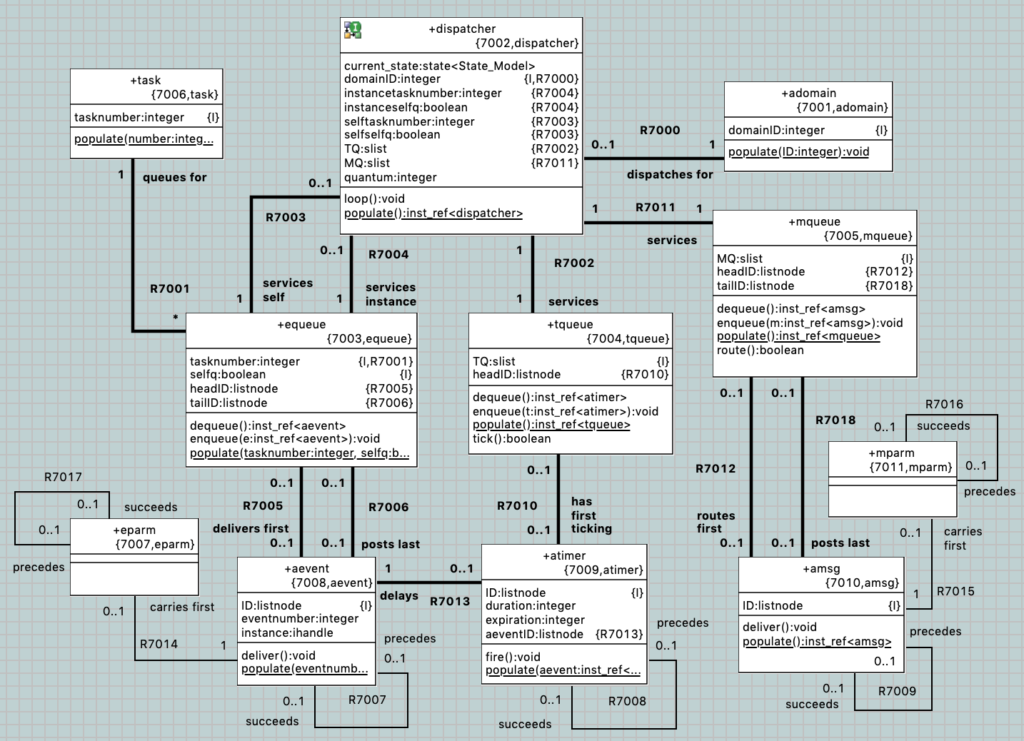
Example Shlaer-Mellor runtime dispatcher architecture.
The dispatcher can be represented with a class diagram and a state machine describing its behavior:
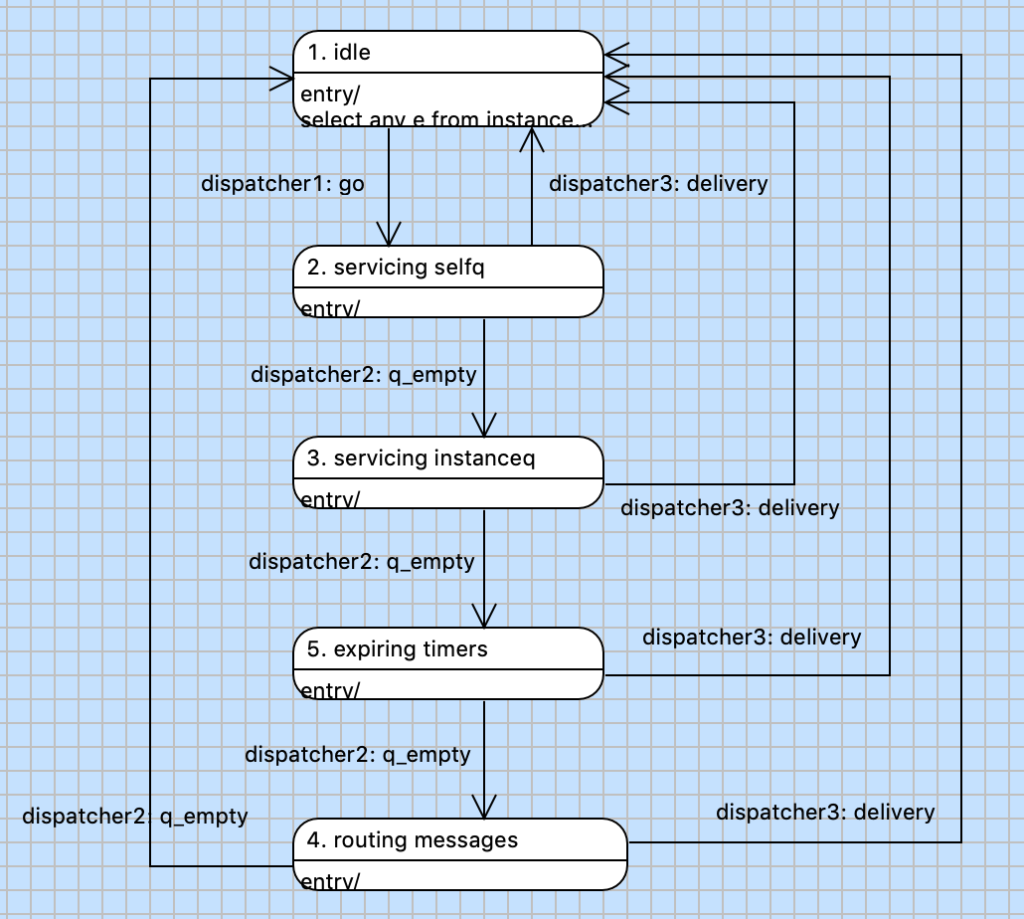
Dispatcher class state machine.
The important distinction is between the runtime’s required semantics and any particular implementation. The rules define the behavior that must be realized; a modeled dispatcher is one way to reason about and implement that behavior.
Historical note: this article describes the Shlaer-Mellor execution rules and an example architecture published in 2019. Specific runtime implementations may differ.